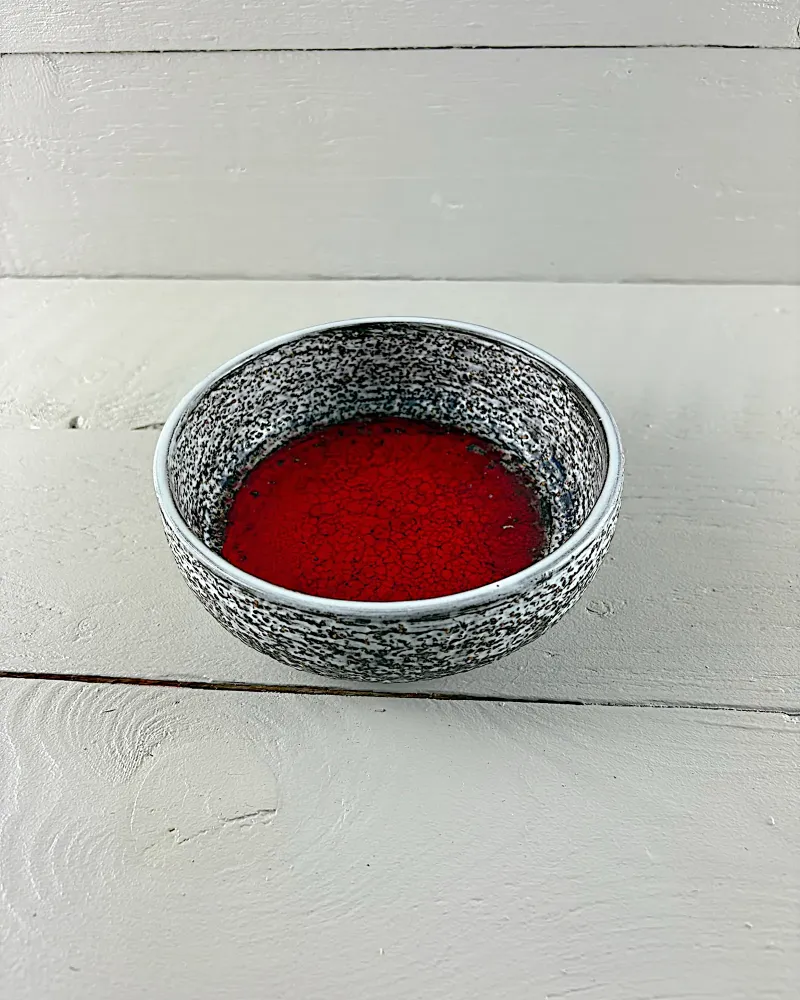
Few Swedish ceramics firms travelled as far from their origins as Upsala-Ekeby. The company began in 1886 as a brick and tile works on the outskirts of Uppsala, and over the following decades grew into one of the country's largest ceramics groups. For collectors today its name stands above all for decorative art pottery made in Uppsala between the 1930s and the early 1970s: vases, bowls, dishes and figures in strong glazes and inventive surfaces.
The founders were a small circle of local businessmen, among them Carl Fredrik Oscar von Bahr, Fredrik Holm and Åke Ekstrand. Bricks came out of the kilns in the very first year, tiles followed in 1887, and for several decades tiled stoves were an important line, until central heating made them obsolete in the mid-1940s. After a difficult start and a financial reconstruction in 1893, von Bahr took control of the business, and from 1915 onwards the company expanded by buying up other Swedish tile and ceramics makers.
The shift towards design followed the broader Swedish movement for better everyday objects, given momentum by the 1917 Home Exhibition at Liljevalchs in Stockholm. Upsala-Ekeby started engaging artists, and by the 1930s it had a real design department. Anna-Lisa Thomson became one of its defining names, and her Paprika series one of its best sellers. Sven Erik Skawonius worked with the factory in the late 1930s and later returned twice as artistic director, in the 1950s and again in the 1960s. Vicke Lindstrand, better known today for his glass, joined in 1942. In the post-war years the studio was shaped by designers such as Ingrid Atterberg, Hjördis Oldfors and Mari Simmulson, who stayed from 1949 to 1972 and is remembered for exotic figures in dark clay and a long run of richly glazed bowls and vases.
Alongside its own production, Upsala-Ekeby became the centre of a wider group. It brought in the Gefle porcelain works in the mid-1930s, Karlskrona Porslinsfabrik in 1942 and Rörstrand in 1964, and later added glass and tableware makers such as Reijmyre, Kosta Boda and Gense. Tile output peaked in the mid-1960s, but the decorative side was already shrinking: the last ceramic artists in Uppsala were let go in the early 1970s, and manufacturing in the city ended in 1977. In the early 1980s the group passed to the investment company Proventus and was broken up. The old factory grounds now house small businesses and schools.
For collectors, the marks are a useful starting point. Pieces are typically stamped or impressed with "UE" or "Ekeby" together with "Sweden", often with a model number and sometimes a designer's monogram, which together help identify the series and narrow down the period of production.
 01