On 8 July 1777 Duke Carl August of Saxe-Weimar-Eisenach granted Christian Zacharias Gräbner a concession to open a porcelain manufactory in Ilmenau, a small town in the Thuringian forest. The works that grew from it, later known as Graf von Henneberg, became one of the longest-running porcelain factories in Germany and stayed in production for 225 years, until 2002.
The early decades were uneven. Gräbner could not repay the money advanced to him and left for Russia, and in 1786 the duke bought the factory at auction. It was then leased to Johann Gotthelf Greiner of the Limbach manufactory, who made it viable only after switching to better kaolin from Bohemia. From 1792 the lease passed to the Erfurt merchant Christian Nonne and his son-in-law Ernst Carl Rösch, who took ownership in 1808. Under them Ilmenau turned out coffee, tea and chocolate services, plates, bowls, pipe heads and small boxes for export, and moved from rustic straw-decorated jugs to classical shapes, including blue-and-white medallions in the manner of Wedgwood's jasperware.
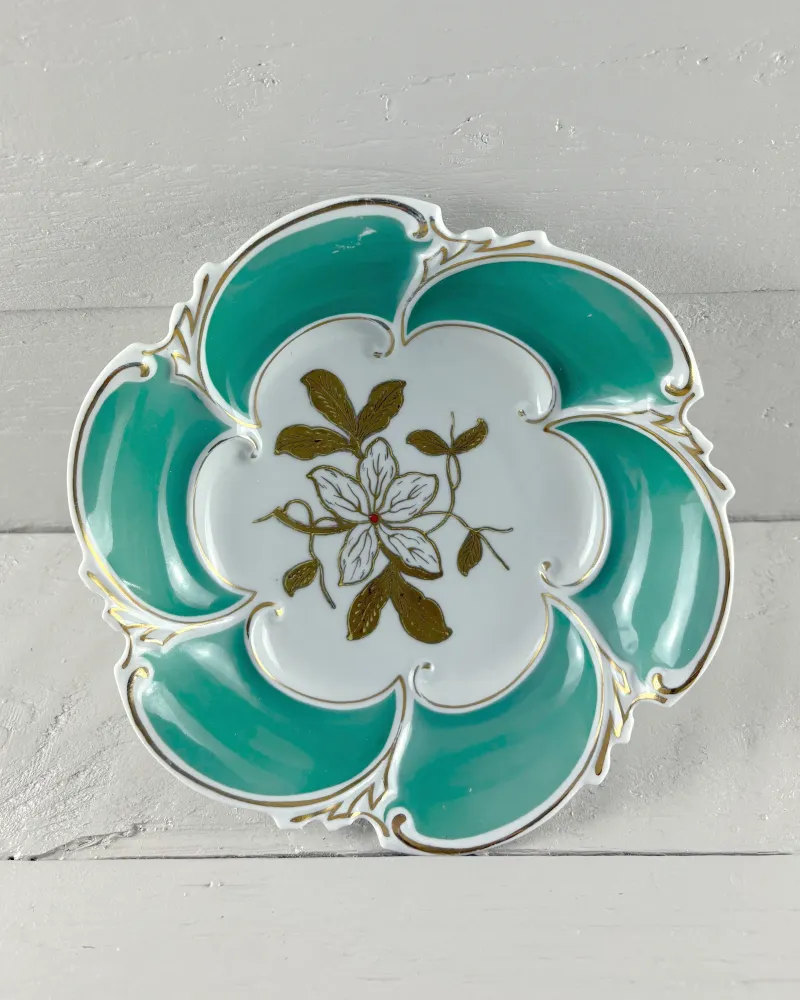
After bankruptcy in 1838 and a period of lessees, a forced auction in 1871 turned the business into a joint-stock company. The new management invested in decoration techniques and patented processes for relief gilding, matte gold and lustre, and the factory became known for flower-painted tableware. The Graf von Henneberg trademark followed in the mid-1930s, usually dated to 1935 or 1936, and names the medieval counts of Henneberg, whose territory once included Ilmenau.
After 1945 production first went largely to Soviet reparations. The factory was then run as a state-owned enterprise in East Germany, and in 1973 Ilmenau's porcelain works were merged into the large Neues Porzellanwerk Ilmenau at Eichicht, which kept the Graf von Henneberg name. It passed into the Kahla ceramics combine in 1979 and employed more than 3,000 people by 1980.
Reunification ended this phase. The works was sold to an investor in 1991, entered insolvency in 2001 and stopped production in 2002. The Graf von Henneberg brand survives today under Eschenbach Porzellan, with household and hotel porcelain made elsewhere in Thuringia.
For collectors, the base mark is the main dating tool. Pieces typically carry a crown over the word Ilmenau, with a ribbon naming Graf von Henneberg and the year 1777. A Made in Germany line appears on postwar pieces, while marks with VEB or the words German Democratic Republic belong to the state-run years, mostly after 1973.
 01