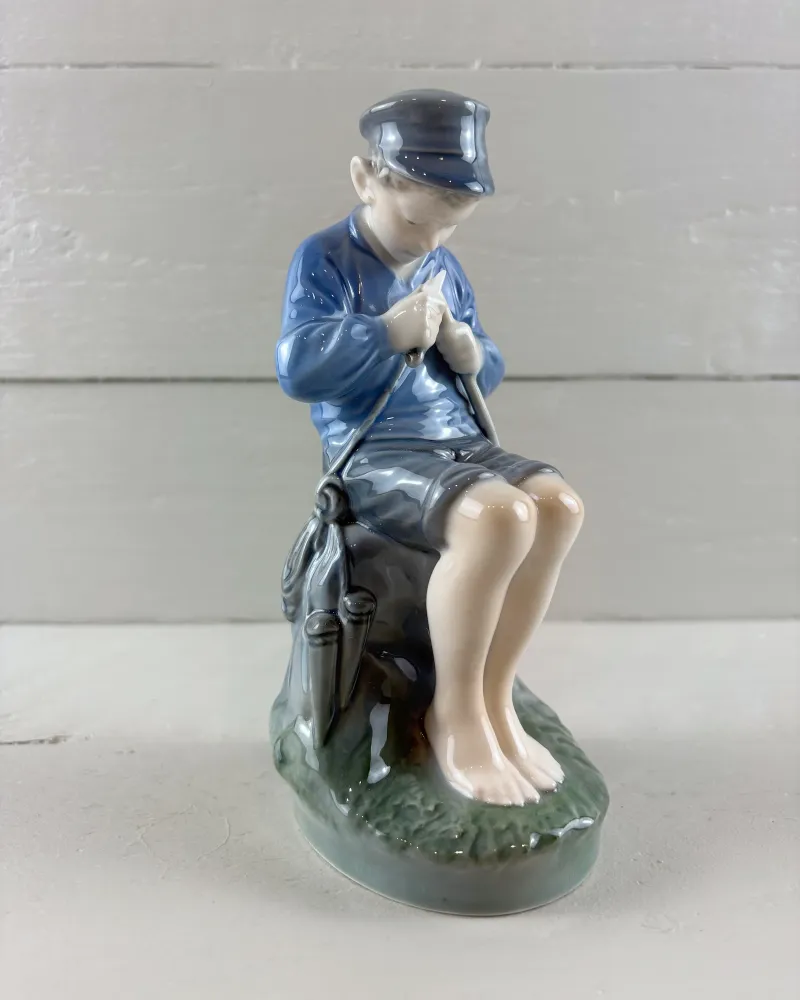
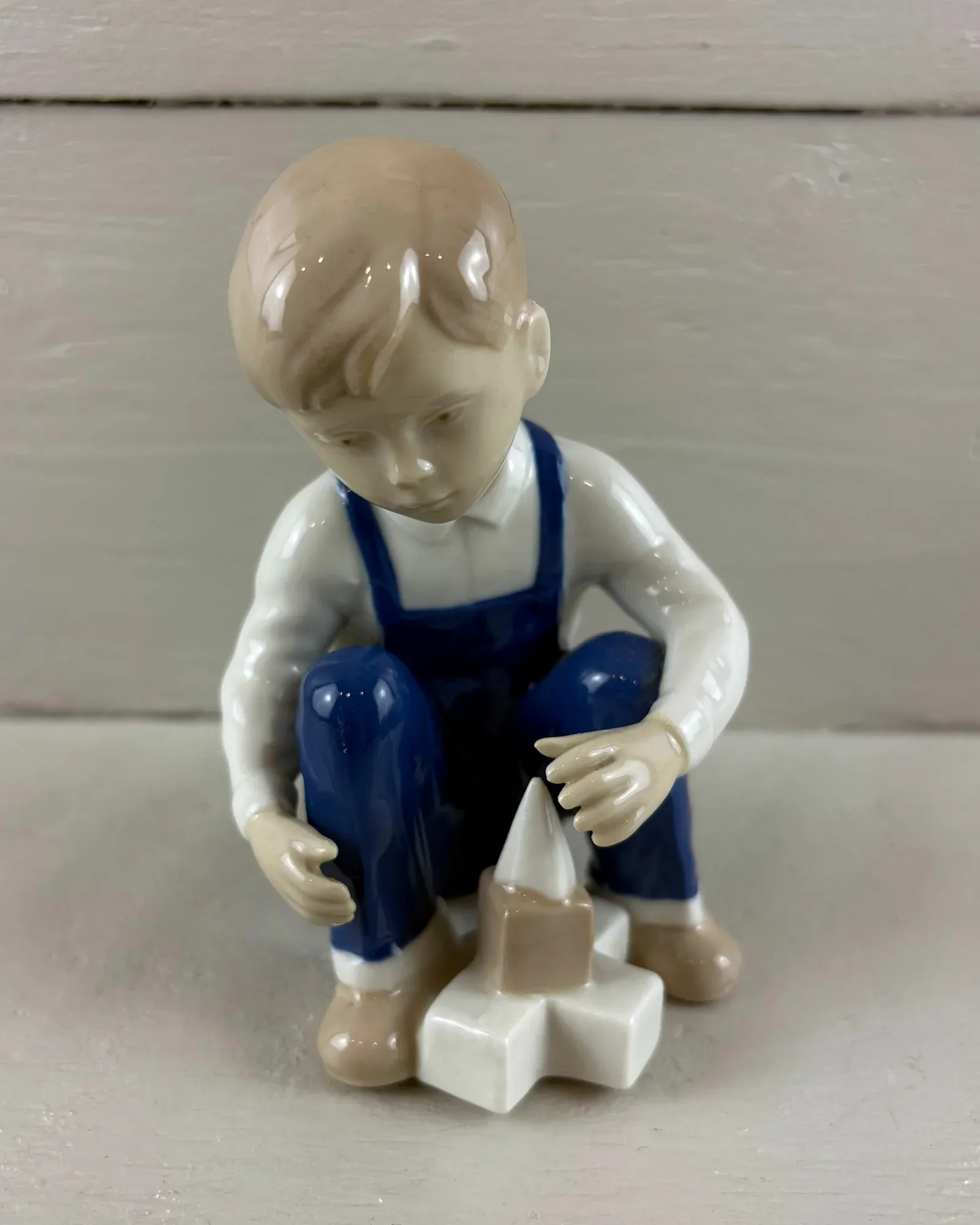
This glazed porcelain figurine of a boy building with blocks is attributed to Gräfenthal, the Thuringian town in central Germany whose porcelain works specialised in decorative figures for much of the 20th century. The boy crouches on the ground with one knee drawn up, carefully setting a pointed, roof-shaped piece on top of a small stack of white and beige blocks.
The modelling keeps the scene simple and quiet. He wears deep blue dungarees with straps crossing at the back over a white shirt, and his light brown hair is brushed to the side above a lowered, concentrated face. The cobalt of the clothing is the strongest colour on the piece, set against soft flesh tones and the pale blocks, all under a smooth, glossy glaze.
Children at play are a recurring subject in 20th-century European figurine porcelain, made to sit on a shelf or windowsill as much as in a display cabinet. This one works well on its own or grouped with other small figures, and its compact, rounded pose reads clearly from every side, including the back, where the crossed straps of the dungarees are neatly painted.
The underside is left unglazed around a small firing hole and carries marks in green. Because the colours were applied individually to each piece, small variations in tone and line make every figure slightly different from the next.
 01 / 09