Gunnar Ander was a Swedish designer best known for the brass, wrought-iron and coloured-glass candle holders he drew for Ystad Metall, the metalworks in Ystad in southern Sweden, and for the art glass he designed for Lindshammars Glasbruk. His candlesticks and candelabra, produced from the 1950s onward, rank among the most recognisable Swedish table objects of the postwar years.
Ander's path into design was not a straight line. Accounts describe a career that moved between craft teaching, architecture and applied art before settling on product design, and the details of his early training are told differently depending on the source. What is consistent is the result: from the late 1940s or early 1950s he worked with Ystad Metall during the years when the company was at its most productive, and he shaped much of what it sent out to export markets.
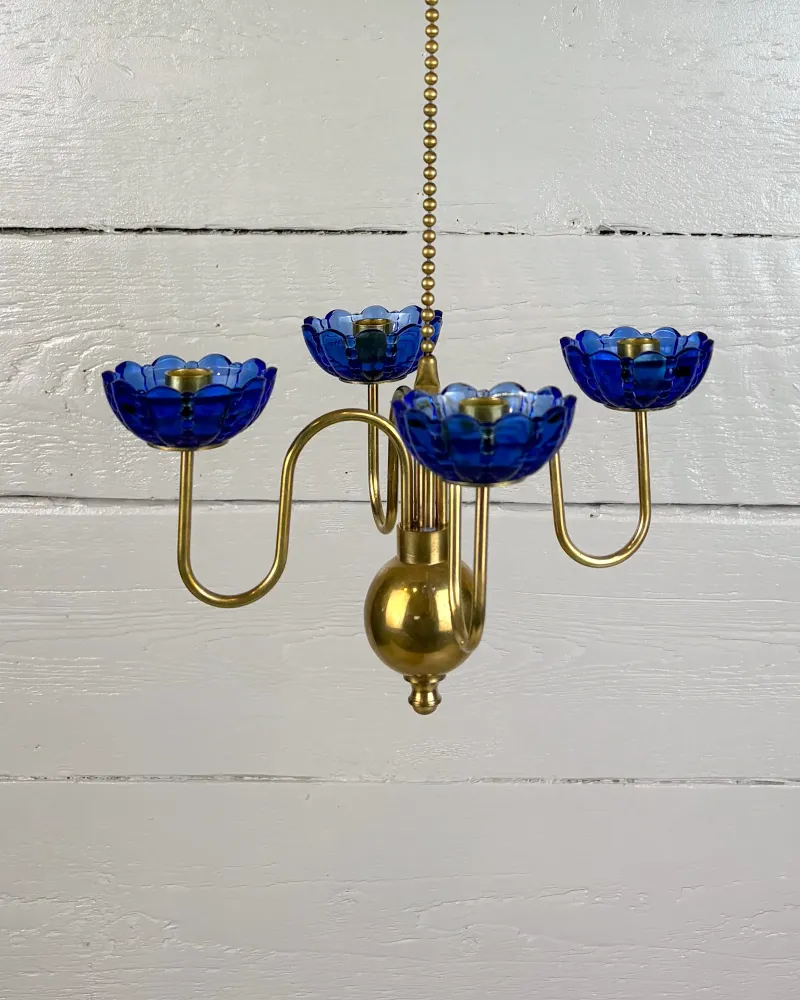
The Ystad Metall pieces share a clear vocabulary. Slim brass or iron rod is bent into loops, S-curves and spreading arms, then finished with a small cup, sphere or disc of glass in blue, amber, red or violet. Candlesticks, candelabra, trays, ashtrays and fire tools all follow the same logic of simple geometry and visible material, close to the functionalist tradition but softer in its curves. Variations on the theme include hanging candelabra whose arms end in flower-shaped glass cups, and sculptural pairs that combine brass with cane or rattan.
Alongside the metalwork, Ander designed glass for Lindshammars Glasbruk in Småland, from decorative vases to more sculptural objects made in the 1950s and 1960s, and he went on working for the glassworks for the rest of his life. He was also a leading designer for Scandia Present AB, where his output ranged from classic brass candlesticks to more modern forms, and he took on interior commissions such as a large carpet for an office in Västerås.
For collectors, Ander is a designer whose work is easy to like and sometimes hard to pin down. Models were made in series and sold widely, so the same form appears with different glass colours and in different sizes. Some pieces he designed for other firms are reported to carry no signature, which means that attribution often rests on form, materials and maker rather than on a name stamped underneath. Original glass in good condition and an even, unpolished brass patina are the details that most often separate a well-preserved piece from a tired one.
 01