Much of the colourful everyday pottery that left the Upsala-Ekeby works between the wars carries the hand of Harald Östergren. A Swedish painter turned ceramic designer, he was the factory's artistic director from 1923 to 1947, and through those decades he defined how a large part of its decorative earthenware looked: vases, bowls, jugs, urns and candle holders made for ordinary Swedish homes rather than for the exhibition hall.
Östergren was born in Stockholm in 1888 and trained as an artist, not as a potter. He studied at the Royal Swedish Academy of Fine Arts in Stockholm from 1913 to 1917 and then continued his studies in Germany. Painting remained part of his practice throughout his life, and landscapes and still lifes signed by him still appear at Swedish auctions alongside his ceramics.
He joined Upsala-Ekeby in Uppsala in 1923, at a time when the company was growing into one of Sweden's major producers of household and ornamental ceramics. As artistic director he designed forms and decorations for serial production, and his early work includes hand-painted pieces with plant and leaf motifs. Through the 1930s his output moved towards the streamlined shapes of Swedish Art Deco and functionalism, with numbered models produced in long runs and in several colourways.
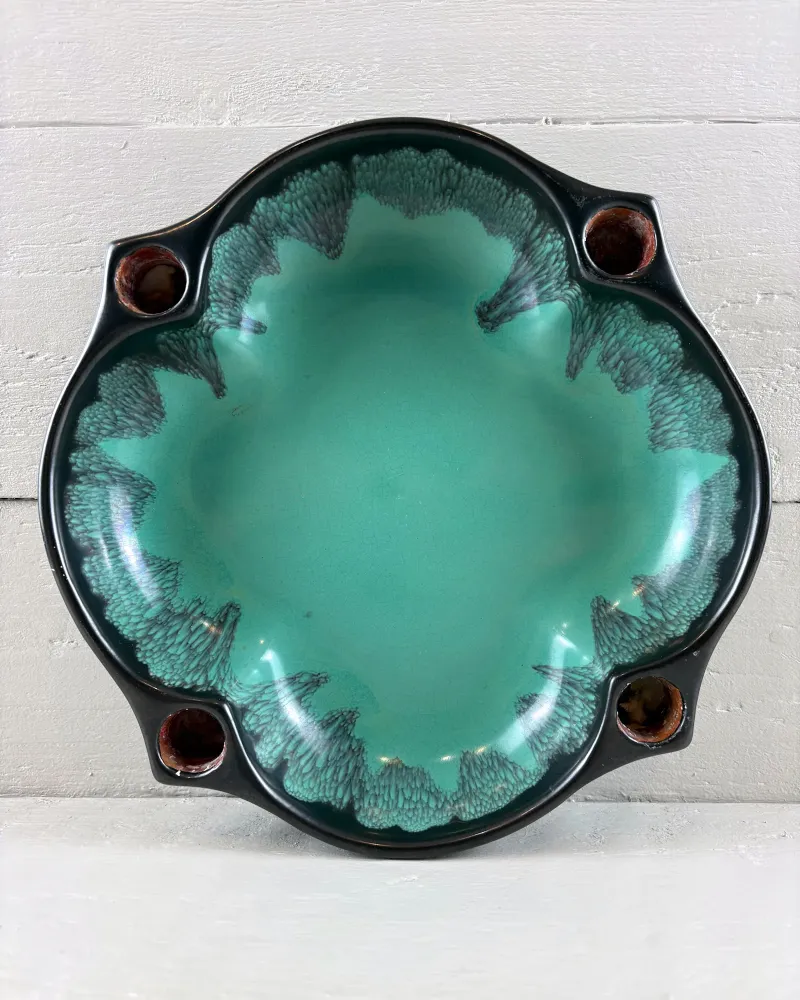
Glaze contrast is the most recognisable feature of his designs. Östergren liked to set a matte or satin black against a glossy colour, such as warm red, orange, green or turquoise, so that the shape of a bowl or vase reads clearly from across a room. Another recurring device is a softer, mottled glaze running into a plain field of colour, which gives simple moulded forms a hand-finished look. Shallow candle bowls and four-candle advent holders were among the practical objects he treated this way, and they turn up regularly at Swedish auctions today.
Pieces from the Östergren period are usually marked on the base with the Upsala-Ekeby factory mark and an impressed model number, and some still carry the company's gold foil paper label. The model number is often the most useful clue when matching a piece to his designs, since many items were not signed with the designer's name. His work is represented in Swedish museum collections, including Upplandsmuseet in Uppsala.
Östergren left Upsala-Ekeby in 1947 and died in 1974. Today his ceramics are collected as an accessible entry into Swedish interwar design: modest in scale, made in large numbers, yet clearly shaped by a painter's eye for colour.
 01