The flowing blue glazes of the Nordlys series, one of the most recognisable lines produced by the Danish pottery Søholm on Bornholm, came from Maria Philippi, a German ceramicist who spent two formative years designing for the factory in the early 1960s. Trained as a studio potter rather than an industrial designer, she brought a craftsperson's feeling for form and glaze to Søholm's stoneware vases, tableware and lamps, and later ran her own workshop in southern Germany for more than three decades.
Philippi was born in Hamburg in 1927. She learned the trade through a classic workshop route: an apprenticeship with the potter Monika Maetzel in Hamburg in the early 1950s, followed by work in small workshops on the island of Juist and in Hamburg. Between 1957 and 1959 she continued her training at the state ceramics school in Höhr-Grenzhausen under Hubert Griemert, a leading figure of German studio ceramics, and qualified as a master potter. During the same period she worked at the Hohlt family workshop in Katzbach. From 1960 to 1962 she taught at the ceramics school in Stoob, Austria.
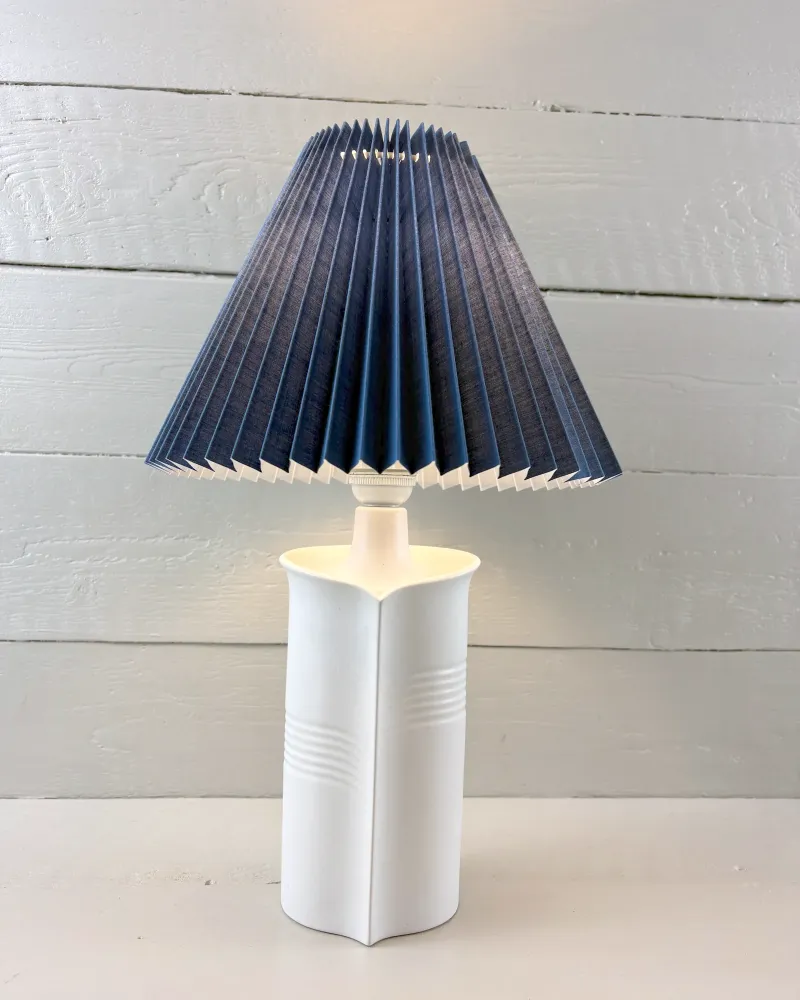
In 1962 she moved to Denmark to work as a designer for Søholm, a long-established pottery in Rønne that was then building a reputation for modern stoneware. Her time there lasted only until 1964, yet her designs stayed in the catalogue well into the 1970s. Besides Nordlys, whose glazes run and flare in shades of blue across the surface, she created the Granit series in blue and brown, pieces with a bamboo-like relief, stoneware wall plaques decorated with birds, and a group of forms built around a simple repeated motif of concentric ovals. Søholm table lamps and vases signed with her monogram also appear regularly on the vintage market.
Her work for Søholm is restrained in outline and generous in surface. Forms tend to be simple columns, bottles and rounded vessels, while the interest lies in the glaze: pooling colour, caramel tones where a darker glaze thins over sharp edges, and incised or impressed bands that catch the light. It is design shaped by someone who threw pots herself, adapted to series production without losing the sense of a handmade object.
After leaving Denmark, Philippi set up her own studio in Merzhausen near Freiburg, where she worked from 1964 until 1998, making wheel-thrown porcelain and stoneware known for elegant shapes and refined glazes. She died in 2004.
For collectors, Søholm pieces designed by Philippi can carry an MP monogram on the base, and the concentric-oval designs often have rings on the underside as well. Because the factory continued producing her designs after her departure, many surviving pieces date from the late 1960s and 1970s rather than from her years on Bornholm.
 01