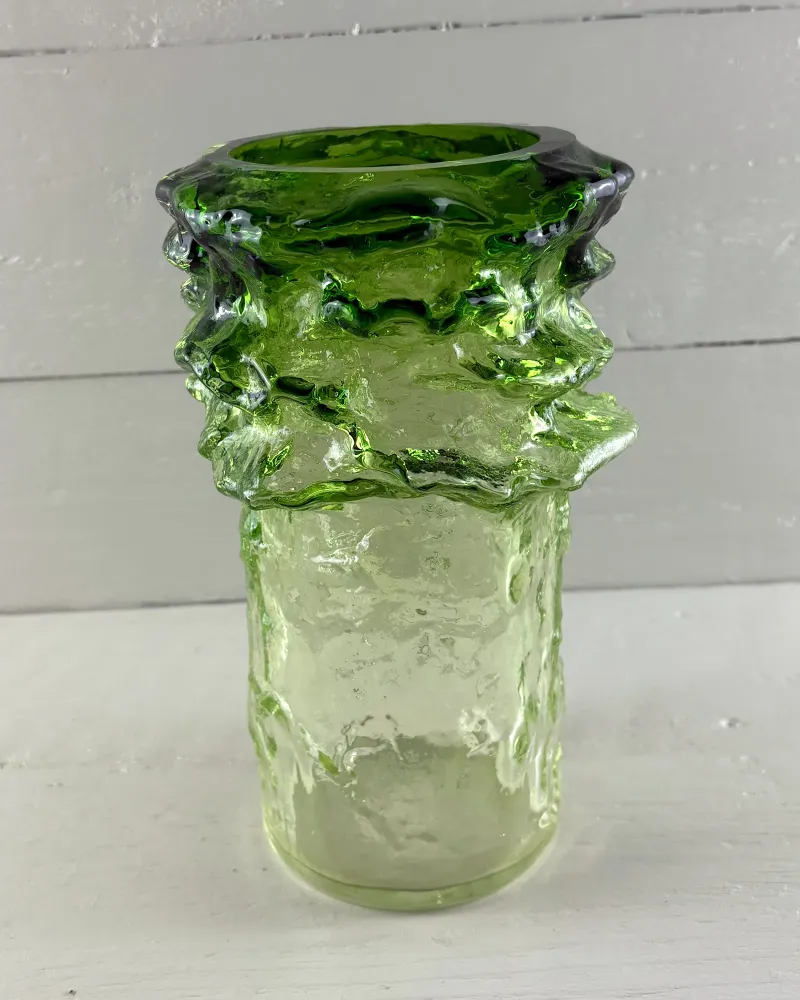
Rock faces, pine bark and the knotted growths on old tree trunks are the starting points of most of Kaj Blomqvist's glass. The Finnish designer, also recorded as Kai Blomqvist, is best known for the thick, heavily textured vases he created for the Kumela glassworks in Riihimäki, mainly during the 1970s, but his career began in metal rather than glass.
Blomqvist studied metalwork at the Institute of Industrial Arts in Helsinki and finished his training in 1956. He then went to Denmark to work for Georg Jensen, designing jewellery and tableware, and his cutlery was shown at the Milan Triennale in 1957. Back in Finland he spent the early 1960s, roughly 1960 to 1965, as a silversmith at Hopeakeskus in Hämeenlinna, the company later renamed Kultakeskus. In 1966 he opened his own studio in Helsinki, working across silver, bronze and other materials.
His most recognisable work came out of his collaboration with Kumela, a family-run glassworks that competed with the much larger Riihimäen Lasi in the same town. Blomqvist became one of the factory's leading designers and gave it a distinctive line of art glass: heavy, thick-walled vessels whose surfaces look weathered rather than polished. The vases are often named after the landscape that inspired them, among them Kallio (rock), Petäjä (pine) and Pahka (burl), and the Natura drinking glasses carry the same loose, irregular texture into everyday tableware. Most of these pieces were made in green, brown, amber, purple or clear glass, with the colour deepening wherever the glass is thickest.
The rugged cliffs of the Finnish archipelago are usually cited as the source of this vocabulary. Instead of the smooth, thin-walled forms associated with earlier Finnish modernism, Blomqvist worked with mass and relief, letting light catch on ridges and hollows so that each piece reads almost like a small sculpture. The same interest in rough natural surfaces appears in his cast bronze bowls from the 1970s.
In 1979 the Finnish Glass Museum in Riihimäki held a solo exhibition of his work, the only one of his career. Later he designed on a freelance basis for other Finnish glassworks, including Humppila and Iittala-Nuutajärvi.
For collectors, signed pieces usually carry an engraved signature with both names, Kumela and Kai Blomqvist, on the base, while many production vases were sold only with the factory label or left unmarked. Because the texture varies from piece to piece, two examples of the same model are rarely identical.
 01