Bo Borgström was a Swedish ceramicist and glass designer who worked in two materials and became best known for the second one. After several years as a studio potter near Stockholm, he spent many years from 1961 shaping the colourful production of the glassworks Åseda Glasbruk in Småland.
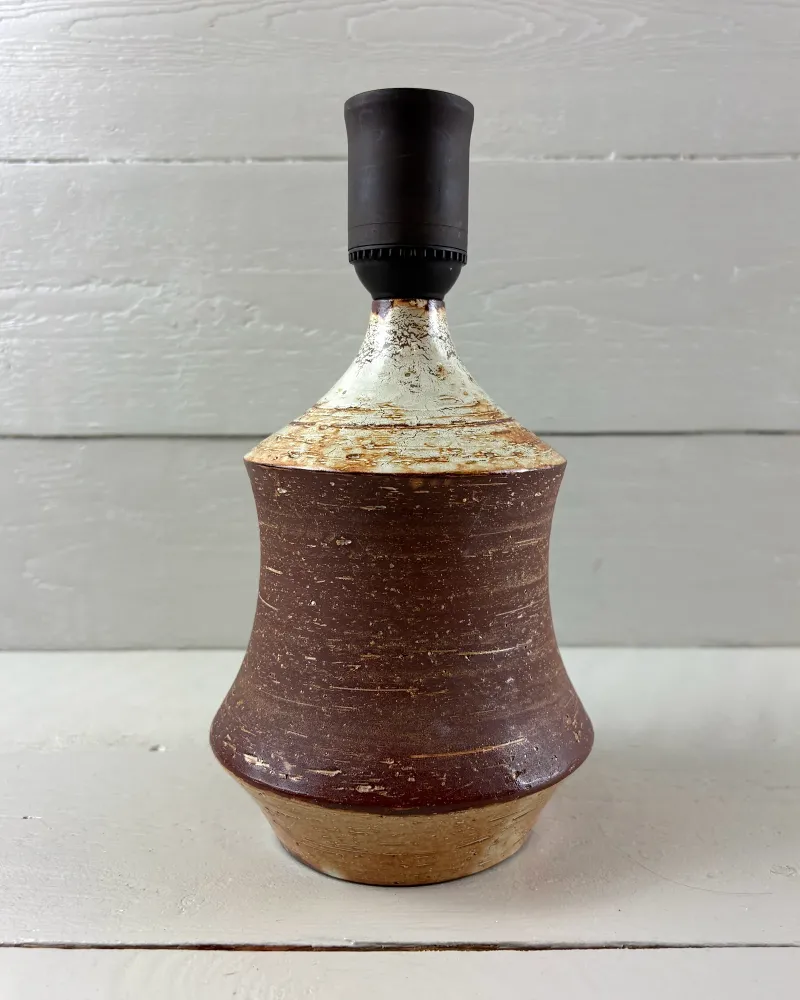
Born in Stockholm in 1929, Borgström studied at Konstfack, the university of arts, crafts and design in the capital, from 1947 to 1951. In 1955 he opened his own workshop, Svensk Form, in Viggbyholm, a suburb north of the city. It operated until 1961, with his wife taking over for a shorter period afterwards. The stoneware made there, from vases and bowls to table lamp bases, was thrown by hand and finished in earthy browns, ochres and pale mottled glazes.
In 1961 Åseda invited him to design glass, and he stayed on as artistic director for many years. His first collection for the factory was a success both artistically and commercially, and he went on to design much of the company's main range. He kept a studio in a Stockholm suburb and travelled to the factory several times a year, staying for a few weeks at a time to experiment with shapes and techniques alongside the glassblowers. Åseda itself was a young company, founded in 1947, and it became part of the Royal Krona group in 1975 before closing in 1977.
Colour was the starting point of much of his glass. He often built a series around a single technique or a new colour combination, and he described his approach as a search for simplicity: begin with something complicated, then take it apart. Vases, bowls, decanters and candle holders in saturated blues, reds and greens, often with trapped bubbles or cased layers, are typical of the 1960s output. A vase in colourless and black glass from around 1965 is held by the Brooklyn Museum. He also designed whisky glasses for the Finnish company Iittala.
For collectors, Borgström's ceramics were usually marked with his name in lowercase, written "bo borgström", sometimes with a label instead. The name is often misspelled in listings, as Bergström or Borgstrom, so it is worth searching under all three. His stoneware from the Svensk Form years is a short and fairly self-contained chapter, while his Åseda glass covers more than a decade of Swedish colour-driven modernism. After retiring he moved to Smygehamn, near Trelleborg.
 01