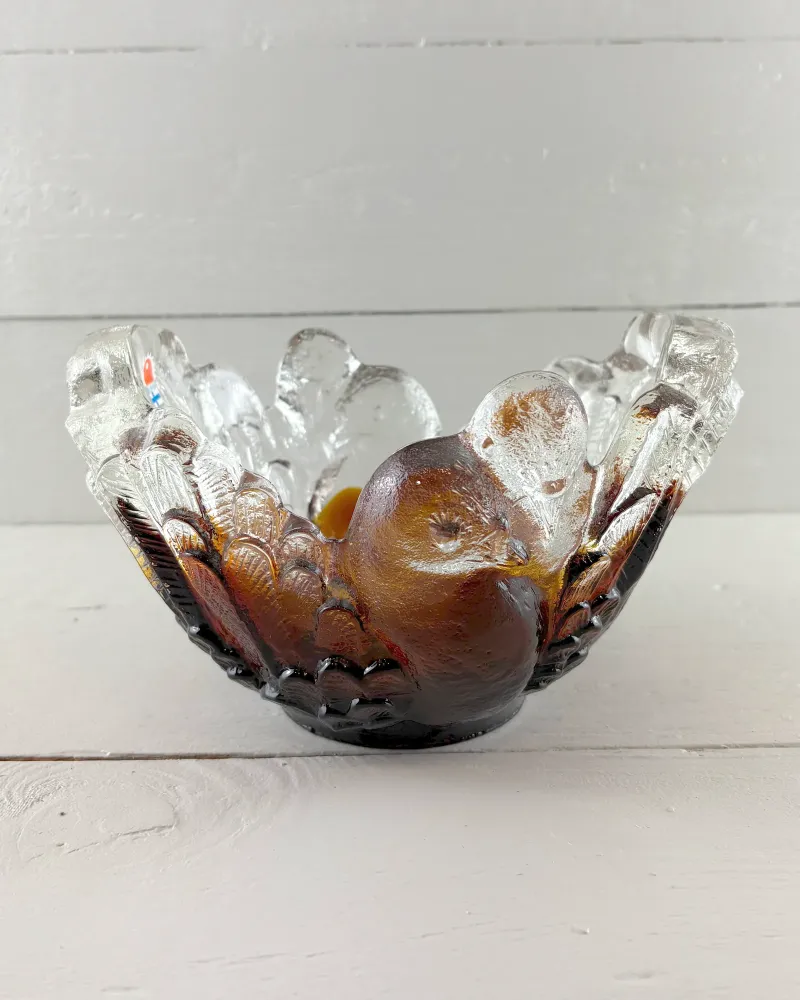
The Kumela brothers grew up with glass: their father Kalle worked at Riihimäen Lasi, the largest glassworks in the Finnish town of Riihimäki. In the early 1930s Toivo, Ilmari and Oiva Kumela set up their own small workshop there, painting and engraving glass bought in from other factories, and in 1937 they lit a furnace of their own. For almost five decades Kumela made everyday Finnish glass – drinking glasses, carafes, bottles, vases and bowls – alongside decorative pieces that collectors now associate with the mid-century period, roughly the 1950s to the 1970s.
The start was difficult. As a small family company next door to Riihimäen Lasi and the Ahlström group, Kumela had to compete with the two dominant names in Finnish glass, and the war years brought production to a halt for a time. After the war the factory grew steadily, and between 1948 and 1960 it also ran mechanised bottle production, turning out up to 20,000 bottles a day.
Design came largely from inside the family and the factory floor. Ilmari Kumela drew the Kumela carafe, which stayed in production from 1946 to 1976. Sirkku Kumela-Lehtonen became the company's in-house designer in 1955 and created hundreds of utility glass models, among them candlesticks first made for her own wedding that later went into wider production. Maija Carlson designed bowls and vases with fine white-thread filigree in the 1950s and 1960s, and the Italian glassblower Armando Jacobino, who worked at Kumela between 1959 and 1970, is known for small hand-formed glass animals and signed vases.
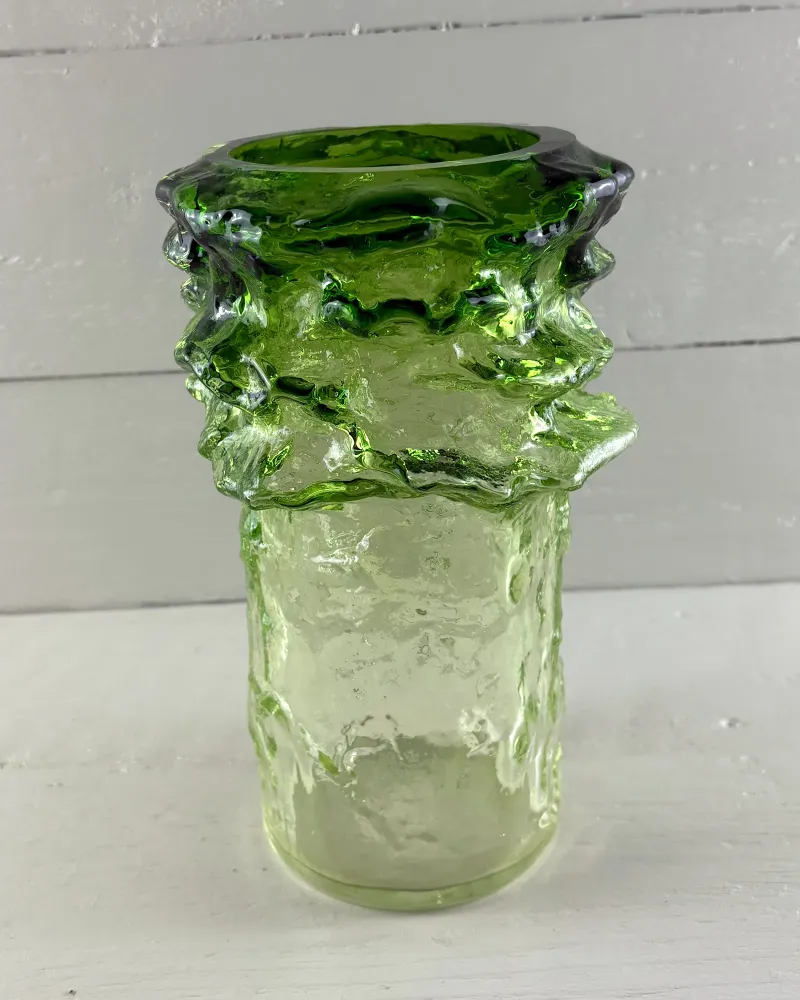
In the late 1960s and 1970s the style moved towards heavier, textured glass. Kaj Blomqvist designed thick-walled vessels with deeply textured surfaces, while Pentti Sarpaneva worked with the silversmiths Turku Hopea on pieces combining glass with metal mounts. Among today's collectors, coloured Kumela pieces, especially in green and lilac, tend to attract the most interest.
The oil crisis of the 1970s raised energy costs sharply, and cheaper imported glass put pressure on small Finnish factories. In September 1976 Kumela was bought by the Humppila glassworks and continued as Kumelan Lasitehdas Oy. During these years some designs by Humppila's artistic director Pertti Santalahti were produced at Riihimäki and signed with the Kumela name, which is why the same model can appear with either a Kumela or a Humppila label. The company went bankrupt in 1981, production ended in 1985, and the factory buildings were later demolished to make way for housing.
Much of Kumela's output was unsigned utility glass, so identification often relies on old catalogues and on the original foil labels, which show the Kumela name with a Finnish flag. Engraved signatures appear mainly on artist-designed and limited pieces.
 01