Lindshammar lies on the border between the municipalities of Uppvidinge and Vetlanda, deep in the forests of Småland, and for much of the twentieth century its name stood for a recognisable kind of Swedish glass: colourful, unfussy and often generous in weight. The glassworks operated from 1905 until its bankruptcy in 2009, and the pieces collectors look for today mostly date from the 1950s to the 1970s.
The village grew up around a succession of industries, starting with a paper mill in 1825 and an ironworks in 1860. The glassworks followed in 1905, set up by a German glassblower named Robert Rentsch. Early production consisted of cut table glass and coloured decorative pieces. In 1916 the business passed to C. J. Petersson, whose son Anton ran it, and during the Second World War the furnaces turned largely to preserving jars and bottles. Erik Hovhammar took charge in 1949, and that year brought a change of direction.
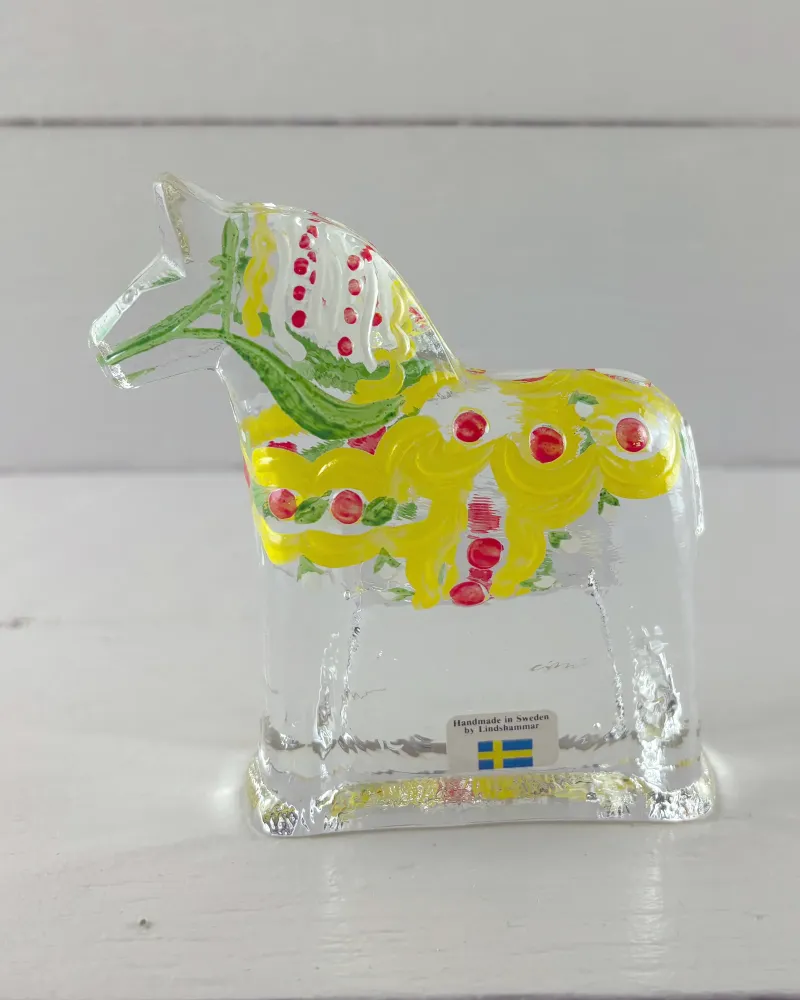
The change was the hiring of Gunnar Ander, the first designer employed at Lindshammar. He stayed until 1976 and made art glass in strong, saturated colours that earned the works its nickname, Glasbruket med färg, the glassworks with colour. In the mid-1960s Christer Sjögren took over the artistic direction, and the character of the production moved towards texture and mass: heavy pressed and moulded glass with rippled, ice-like surfaces, architectural glass panels, suncatchers, window ornaments and small animal figures, among them painted Dala horses. Other designers who worked for the glassworks include Gösta Sigvard, Prince Sigvard Bernadotte, Catharina Åselius-Lidbeck, Tom Möller and Matz Borgström, and the artist Erik Höglund contributed as a freelancer between 1978 and 1981.
The best-known public commission is Edvin Öhrström's Kristallvertikalaccent at Sergels torg in Stockholm. Öhrström worked with prisms in gemstone colours at Lindshammar, and the 130-tonne steel pillar is clad in glass made there. It was inaugurated in 1974.
Like many Swedish glassworks, Lindshammar struggled in the later decades of the century. It went bankrupt in 1981 and was bought in 1984 by Ulf Rosén. From 1998 it belonged to CG Holding, and a second bankruptcy in 2009 ended production. Rosén and Claes Hovhammar bought the glassworks' own collection of glass and photographs from the bankruptcy estate. The Smålands museum today lists more than 600 Lindshammar objects in its records, and the old works area in the village has a café and a bed and breakfast.
For collectors, two kinds of marking are worth knowing. Some pieces carry a paper label reading "Handmade in Sweden by Lindshammar", and others are engraved "Lindshammar Sweden Glass". Together with the form, colour and surface texture of the glass, these marks help place a piece within the Ander and Sjögren periods.
 01