For more than half a century, the look of Holmegaard glass was set by one person. Per Lütken, the Danish glass designer who became the factory's artistic director in 1942 and held the post until his death in 1998, created over 3,000 designs there, ranging from everyday drinking glasses to sculptural art glass.
Born in Copenhagen in 1916, Lütken began as a painter's apprentice before studying at the School of Danish Crafts between 1932 and 1938. At Holmegaard he took over from Jacob E. Bang, whose functionalist glass had defined the factory in the interwar years. Although Lütken never blew glass himself, he worked in close partnership with the factory's glassblowers, and his designs grew out of that collaboration.
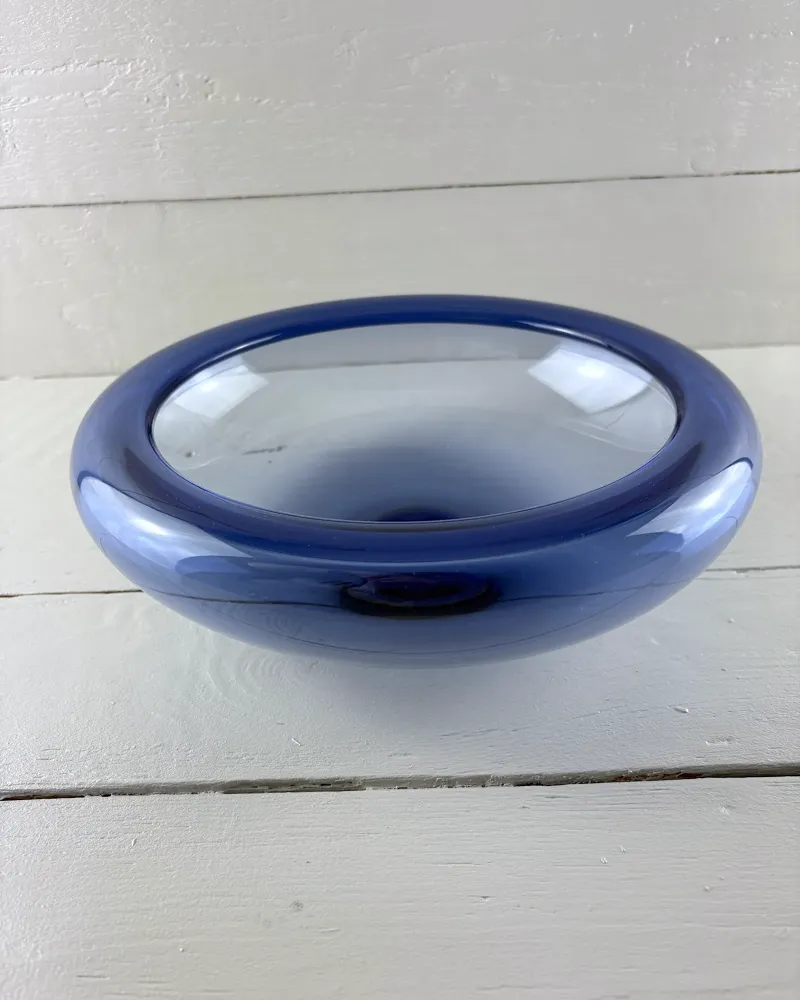
Much of his mid-century work favours soft, flowing forms that let the molten character of glass show through. The Arne bowl of 1955, reissued under the name Provence in 1982, is a clear example and remains one of the most familiar Holmegaard shapes, while the Selandia dish is another sought-after piece from his organic period. The 1960s brought a change of mood: the Perle drinking glass appeared in 1966, and the Carnaby series of the late 1960s moved towards bold colour and full, sculptural volumes that reflected the pop spirit of the time.
Functional glass remained central throughout his career. Skibsglas, the ship's glass of 1971, and the Idéelle range of 1978 show his steady output for the table. Later work includes the Charlotte Amalie range, the Lava series and the Laguna bowls of the 1980s, evidence that he kept experimenting with colour and texture well into his final decades.
Lütken's long tenure gives Holmegaard's postwar production an unusual continuity, and his designs span almost every category the factory made. His work is represented in the Victoria and Albert Museum in London, and in 1994 he received an honorary grant from the Danish National Bank's Jubilee Fund. For collectors, pieces from the Provence, Carnaby and Skibsglas families offer a clear view of his range, from understated clear forms to strongly coloured statement pieces.
 01