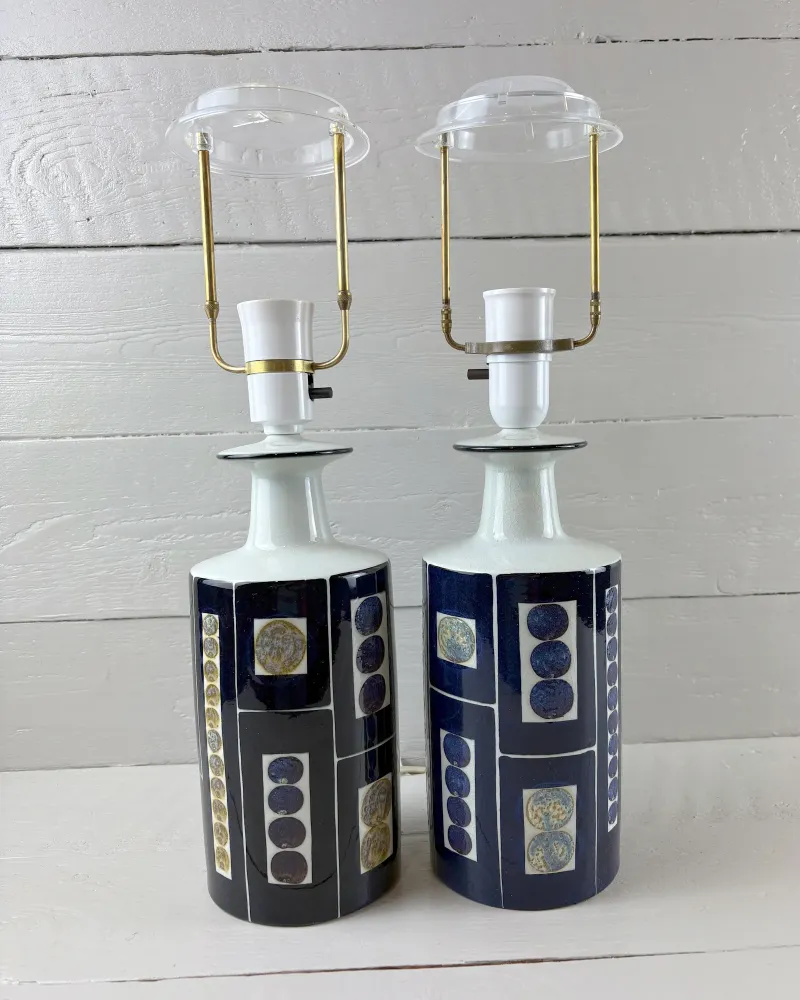
Inge-Lise Koefoed is a Danish ceramicist and surface decorator best known for her hand-painted faience for Royal Copenhagen, above all the graphic patterns of the Tenera series from the 1960s. Her work also reached a wider audience through ceramic lamp bases made for the Copenhagen lighting firm Fog & Mørup, where her bold geometric decoration was paired with brass and acrylic fittings.
She belonged to a group of young women artists who joined the faience and stoneware department of Royal Copenhagen at a moment of renewal. In 1958 Nils Thorsson became art director and began recruiting talented newcomers from Denmark, Norway and Sweden to give the factory a fresh, contemporary face. Dealer sources describe Koefoed as one of about six such artists who shaped much of the faience of the era. One source places her training at the Copenhagen school of arts and crafts in the late 1950s, and her birth year is most often given as 1939.
Tenera was introduced under the Aluminia name, the faience works that had belonged to the Royal Copenhagen group since the nineteenth century, and it favoured bold, graphic decoration. Its shapes were mostly drawn by Thorsson, while the painted patterns were left to the individual artists. Koefoed's decors are among the more assertive ones: rectangular fields filled with rows of circles, dotted columns and small medallions, set in deep cobalt blue with accents of ochre, grey and white. Almost every piece was painted by hand, so no two vases or lamps are quite alike.
Lamps are the other place where her decoration turns up. Fog & Mørup, founded in 1904 and a leading Danish lighting maker through the 1960s and 1970s, mounted Royal Copenhagen bases on its own fittings and printed its name on the underside. Listings from the period mention table lamps and tall floor lamps, sometimes sold as matched pairs, with decoration credited to Koefoed.
Her name appears in several spellings, including Kofoed and Ingelise, and later pieces are sometimes catalogued under the married name Sørensen, which is worth knowing when searching archives and auction records. Collectors can usually confirm an authentic piece from the backstamp: the Aluminia or Royal Copenhagen wave mark, a pattern and shape number, and the initials of the painter. Lamp bases additionally carry the Fog & Mørup Copenhagen mark. Because the painting was done by hand, small differences in colour and layout between two items from the same series are normal.
Her reputation rests on the objects themselves rather than on a published biography. Her Tenera work shows how Royal Copenhagen's mid-century faience combined studio-style decoration with factory production, and why those pieces are still sought after by collectors of Danish design.
 01