Many of the stoneware lamps, wall lights and vases that left Søholm on Bornholm in the 1960s and 1970s began as shapes drawn by Poul Brandborg. The Danish ceramic designer worked at the Rønne pottery in close partnership with decorator Noomi Backhausen, and the two names appear together on most of the pieces collectors associate with him today.
The division of labour in that partnership is unusually clear. Brandborg was responsible for the forms, and Backhausen painted or modelled the decoration onto them. Their best-known joint ranges are the Erika and Cactus series, which ran through table lamp bases, vases, bowls and wall-mounted pieces. Dealers and auction houses usually credit the pieces to both designers, so his work is rarely listed under his name alone, and his first name is often spelled Paul in catalogues and auction records.
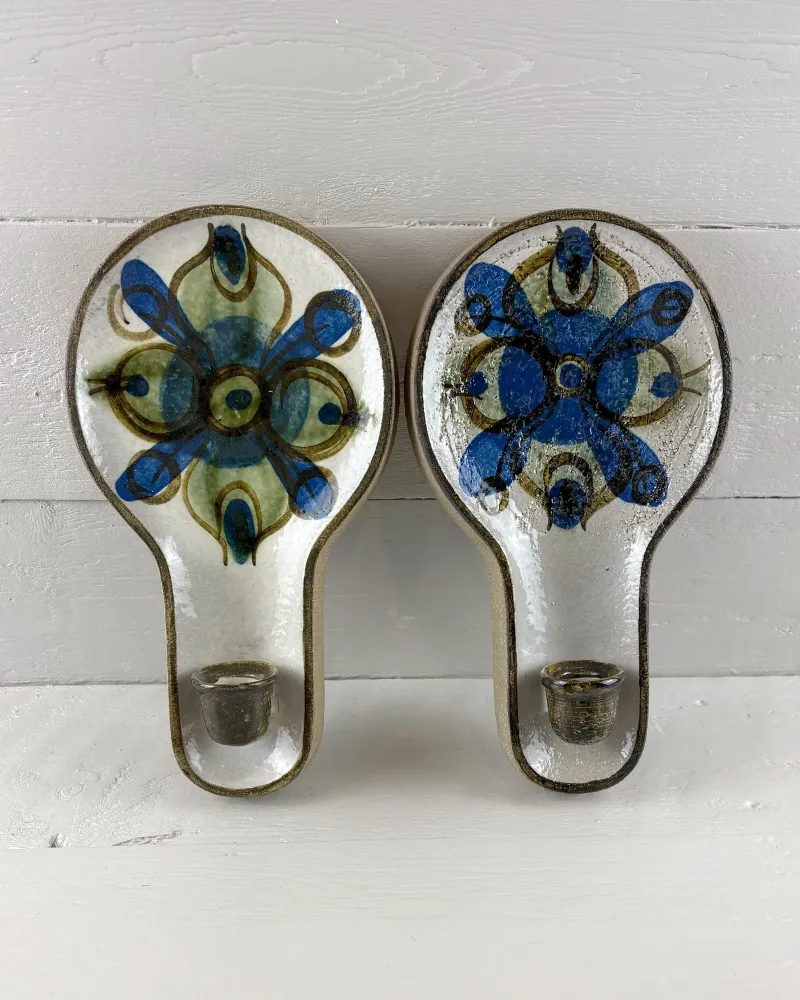
Lighting takes up a large share of the output attributed to him. Wall lamps from around the mid-1960s pair glazed stoneware with brass fittings, and some multi-part wall light sculptures stretch across a wall as long relief panels with only partly glazed surfaces. Alongside these came table lamp bases, pedestal vases and wall candle holders such as model 3220, a one-piece stoneware sconce shaped like a long-handled spoon with an integrated candle cup.
His shapes tend to be simple and solid, with few details competing for attention. Smooth outlines and generous surfaces leave room for the decoration, and the unglazed edges and backs show the coarse, sandy Bornholm clay. The same form was often issued in several glaze and colour variants, from earthy browns to white grounds painted in cobalt blue and green.
Brandborg's designs come from the modernist chapter of Søholm, a pottery founded in 1835 that kept producing on Bornholm until 1996. His pieces are typically marked on the reverse with an impressed or stamped Søholm Bornholm Denmark mark and a shape number, sometimes with a decorator's mark next to it. Those numbers and stamps are the most reliable way to confirm an attribution, since the designer's own name is not part of the mark.
 01