In the forested countryside of Östergötland, near Finspång, Reijmyre has been blowing glass since 1810, which makes it one of the oldest Swedish glassworks still in operation. The village is also written Rejmyre, and among collectors the works is best known for its mid-twentieth-century art glass: heavy, colourful and often layered pieces made from the 1950s into the 1970s, following an earlier tradition of ruby-red and other richly coloured tableware.
The founders were the hunting master Johan Jacob Graver and Baron Mattias Alexander von Ungern-Sternberg. Their timing was practical: Sweden had lost its Finnish glassworks the year before, and the surrounding woods could keep the furnaces fed. The first products were plain, bottles, window glass and household glass, but in the 1830s Reijmyre became the first Swedish works to produce pressed glass.
By the early 1900s the works was among the country's larger glassmakers, with several hundred employees, and it was one of the first to give female designers a place in the studio, among them Betzy Ählström and Anna Boberg. In 1902 its Jugendstil overlay glass drew attention at the Turin exhibition. The interwar years were less steady, with ownership changing hands repeatedly, but the 1930s brought a revival built on ruby-red, Venetian-blue and emerald-green glass by Björn Trägårdh and Monica Bratt. Bratt, who worked at Reijmyre from 1937, gave the factory its best-known colour, a deep red that is still associated with the name.
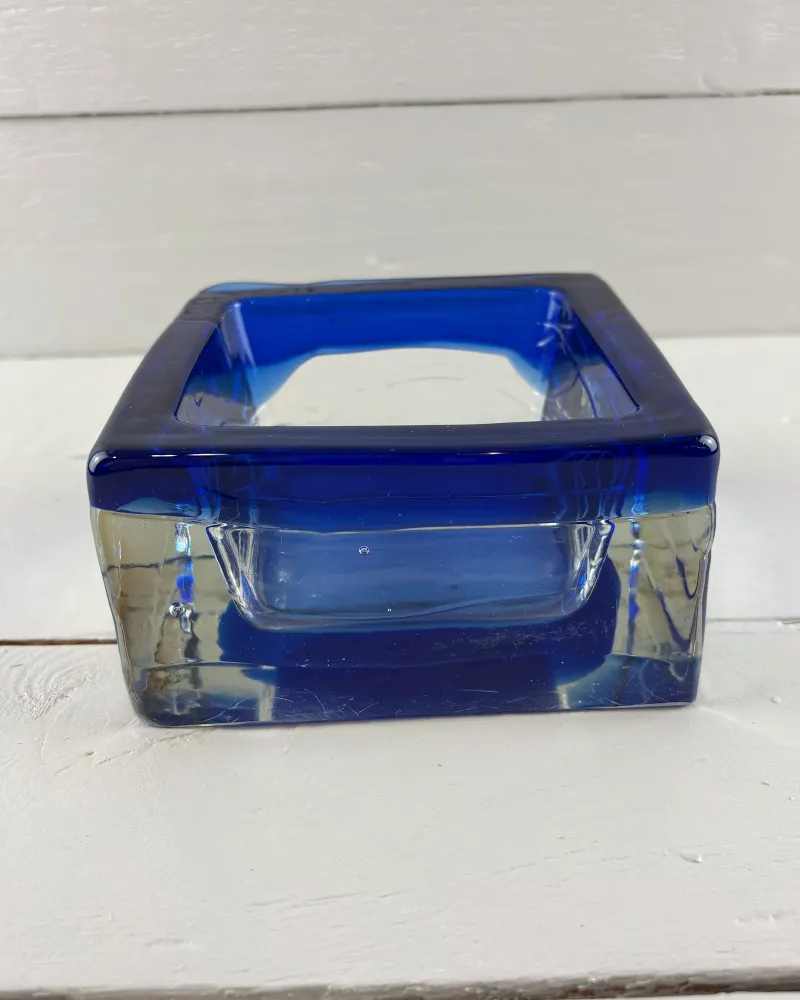
The decades that matter most to collectors began in 1950, when Lennart Rosén took over the works, which he owned until 1975. Under him Reijmyre widened its range of designers, bringing in Johnny Mattsson, Paul Kedelv and Bert Kindaker, and the factory produced a good deal of sculptural bowls, vases and lamp bases in layered colour alongside its more traditional glass. This period is the one most often meant when a piece is described simply as vintage Reijmyre.
After 1975 the ownership changed again and the works went through years of financial difficulty. Reijmyre was declared bankrupt in 2015 and restarted the same October under new owners, among them Ulf Rosén and Björn Waage of the Norwegian Magnor Glasverk. Today it makes mouth-blown glass, runs a shop and a museum, and lets visitors watch glassblowing at the furnace; some of Bratt's designs are still in production.
For anyone identifying older pieces, the marks are a useful guide. Reijmyre used blue and silver foil labels reading “Reijmyre Kristall, Sweden”, or an oval version reading “Reijmyre, Sweden”, sometimes alongside a blue and yellow paper “Handmade” label. Signed pieces from the 1950s can carry the letters “R-e” with a year, for example “R-e-59”, and often a pattern number, in some cases preceded by the designer's initial, such as “K” for Kedelv. Many pieces are unmarked, so colour, weight and construction matter as much as any signature.
 01