Rörstrand takes its name from a manor on the shore of Klaraviken, just outside Stockholm, where in 1726 a small workshop began producing tin-glazed faience. Over almost three centuries it became Sweden's oldest porcelain and ceramics manufacturer, making everything from blue-and-white tableware to studio stoneware and lamp bases. The pieces collectors of Scandinavian design look for most come from the middle of the 20th century, when the factory in Lidköping was at its most inventive.
The enterprise was a state-backed attempt to make Sweden less dependent on imported Dutch faience. The German potter Johann Wolff is named as its founder, and the works received royal privileges in 1729. A technical and artistic head, Anders Fahlström, arrived in 1740 and led a first flowering of cobalt-blue decoration. From 1758 wares were marked with the Rörstrand name rather than simply "Stockholm", and in the 1770s the factory added stoneware and flintware modelled on English examples. Transfer-printed earthenware followed in the early 19th century, then bone china in 1857 and feldspar porcelain in 1881.
Around 1900 Rörstrand moved into Art Nouveau under the art director Alf Wallander, whose work was shown at the Paris world exhibition. A Finnish subsidiary, Arabia, had been founded in Helsinki in the 1870s and was sold to Finnish owners in 1916. The company bought the Göteborg porcelain factory in 1914; after the old Stockholm works were closed in 1926, production was concentrated in Gothenburg and Lidköping, and by 1941 it was all in Lidköping. In 1930 Louise Adelborg's National Service, later known as Swedish Grace, appeared at the Stockholm Exhibition.
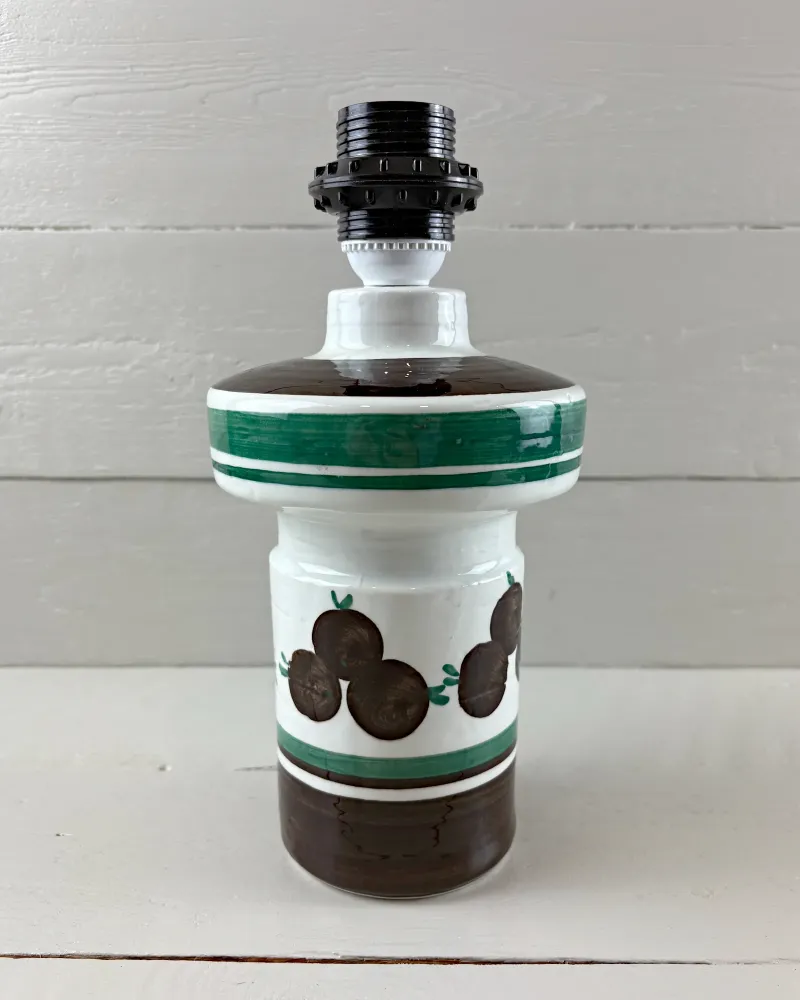
From 1931 Gunnar Nylund steered the factory towards a functionalist, material-led style, and his Frigi series dates from 1941. Hertha Bengtson, Carl-Harry Stålhane and Marianne Westman shaped the post-war decades: Westman's Mon Amie (1952) and Picknick, Bengtson's Koka Blå and Blå Eld, and Stålhane's stoneware. Sylvia Leuchovius, Olle Alberius and Inger Persson, whose Pop teapot dates from 1968, carried the look into the 1960s. Stoneware and chamotte lamp bases and vases by Nylund, Stålhane, Persson and others from the 1950s and 1960s are among the most frequently collected Rörstrand objects today.
Much of the factory's character came from hand work. Painters employed in the Lidköping art department decorated forms designed by others, and some signed their work with initials; Lars Thorén, active there from 1935 to 1957, is one example. Rörstrand's marks typically combine the name with a crown motif, a device that appears from around the 1880s and varies over time, which helps date pieces and separates studio-type work from tableware.
From the 1970s Rörstrand cooperated with Arabia, and over the following decades the company changed hands several times, including ownership by Upsala-Ekeby and the Finnish Wärtsilä group, before Hackman acquired it in 1990 together with Arabia, Nuutajärvi and Iittala. Financial investors took over in 2004, the Lidköping factory closed on 30 December 2005, and in 2007 Fiskars took ownership of the brand through Iittala. The old works now house the Rörstrand Museum, and the brand lives on within Fiskars, with classics such as Swedish Grace and Mon Amie back in production.
 01