A wall of thick glass blocks set in concrete, delivered to Middlesbrough in 1963, is among the earliest works attributed to Christer Sjögren, the Swedish glass designer who spent most of his career at the Lindshammar glassworks in Småland. Born in 1926, he gave the works much of its character through the second half of the twentieth century, and his clear, heavy, textured glass is among the most recognisable Swedish glass of those decades.
In the 1960s Sjögren moved to the front of Lindshammar's design work, alongside Gunnar Ander, whose saturated art glass had defined the previous decade. Sources differ on the exact year he became chief designer, placing it between 1962 and 1965, but he remained associated with the glassworks for decades. A pressed piece in the collection of the Smålands museum is inscribed with his name and the year 1991, which shows that he was still designing for Lindshammar long after the period collectors prize most.
The Middlesbrough commission shows where he started. Made of thick, faceted glass blocks in several colours, it was installed at Scandinavian House in two large prefabricated sections. Its attribution to Sjögren was worked out by a local researcher and later confirmed by the glass specialist Andy McConnell. The same slab-like thinking runs through his architectural glass for Lindshammar, a line of heavy panels and slabs.
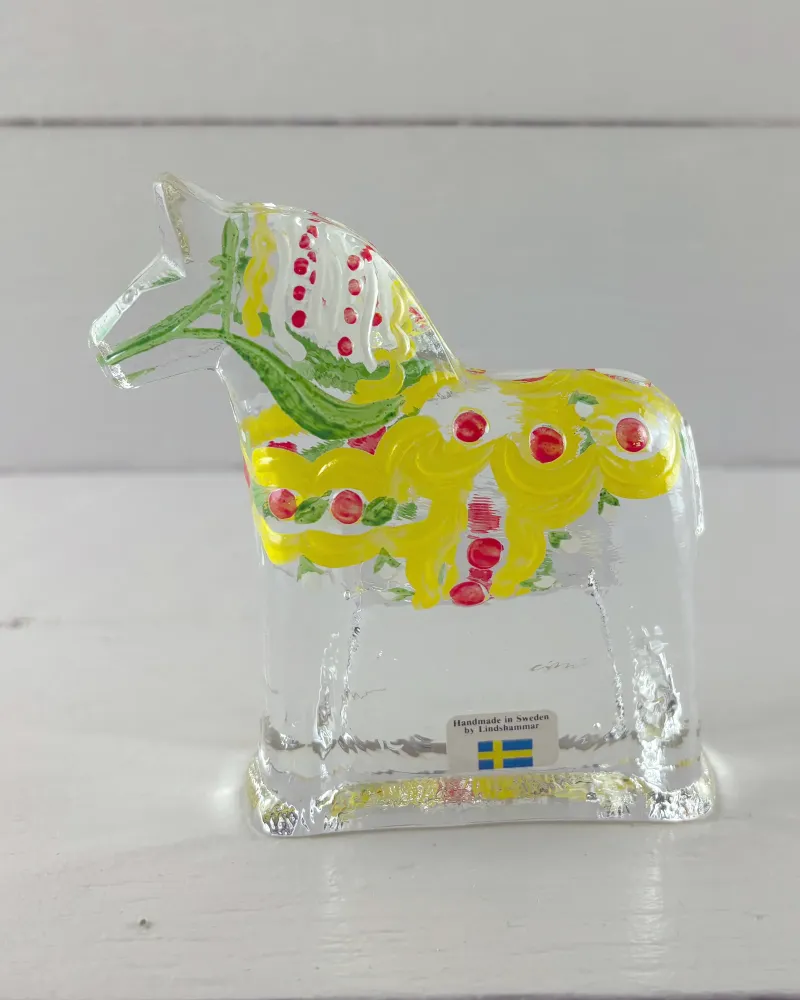
At the other end of the scale he designed small pressed objects: round suncatchers and window ornaments with moulded patterns, glass handles with brass mounts, and animal figures, including painted Dala horses. Alongside these came vases and sculptural pieces. Dealers list ruby-red vases from the 1960s under his name, and square-sided blown vases with horizontal banding from the 1970s, while his sculptures in clear, polished glass are less easy to date.
What ties these together is an interest in the surface and weight of glass rather than in applied decoration. He worked often in clear glass and let cast and rippled textures do the work, an approach dealers and collectors describe as a distinctly Swedish modernism.
For collectors, signed pieces usually carry an engraved mark on the base reading "Chr Sjögren Lindshammar Sweden" or a close variant, though many works from his productive years were never signed, so form and texture matter when attributing an unmarked object. The Nationalmuseum in Stockholm holds two of his objects, and the Smålands museum keeps a larger group among its Lindshammar holdings.
 01