Stylised female figures, exotic birds and densely patterned leaves drawn in cobalt blue run through the work of Mari Simmulson, the Estonian-born Swedish ceramicist best known for more than two decades as a designer at Upsala-Ekeby. Before that she spent four formative years at Gustavsberg, and together these two factories define her place in mid-century Swedish ceramics.
Her route to Sweden was far from direct. Born in 1911 in Saint Petersburg to Estonian parents, she moved to Estonia with her family after the Russian Revolution and studied at the state art school in Tallinn during the 1930s. A training period at the Arabia factory in Helsinki in 1937 introduced her to industrial ceramics, and she went on to study sculpture at the Academy of Fine Arts in Munich. In 1944, as the war reached Estonia, she fled across the Baltic to Sweden as a refugee.
In 1945 she joined Gustavsberg, then led by Wilhelm Kåge, and her work was shown at the company's Stockholm shop in 1948. In 1949 she moved to Upsala-Ekeby, where she remained until 1972. There she worked alongside Ingrid Atterberg and Hjördis Oldfors, forming a notable group of women designers at the factory. Her output was broad: vases, bowls, dishware, wall plates, figurines and larger sculptural pieces, including the half-metre Balinesiskan figure produced in a numbered edition of 100. After Upsala-Ekeby she continued at the Deco ceramics factory in Helsingborg.
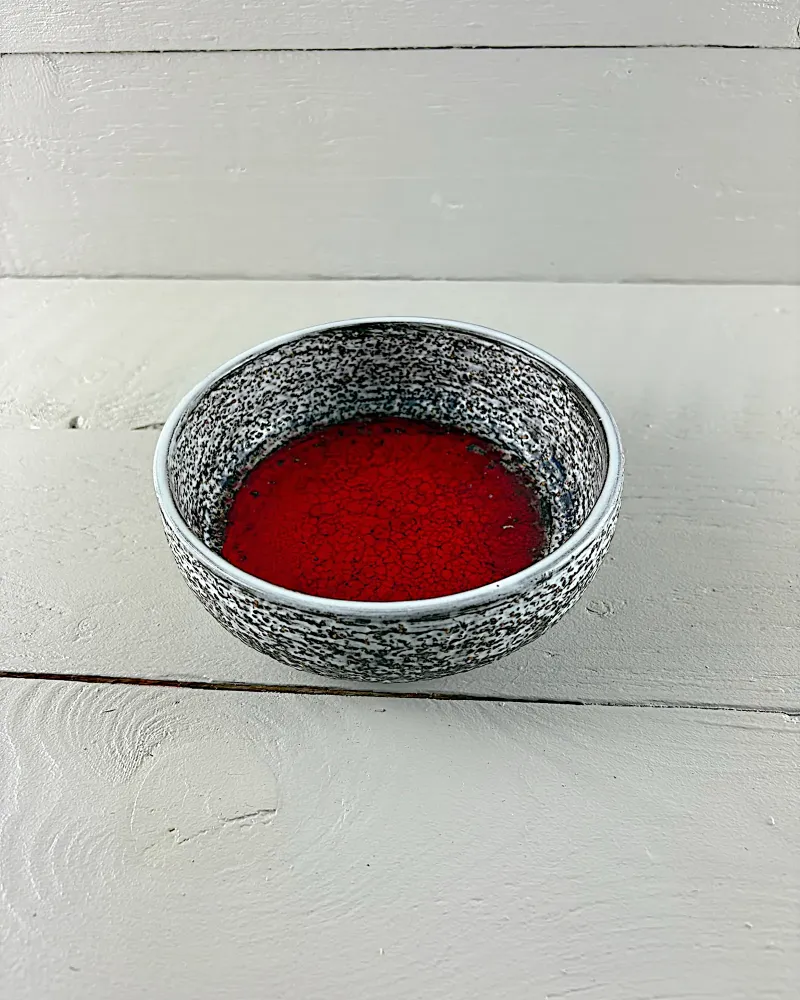
Simmulson's decoration draws on Baltic and Russian folk art as well as on distant cultures, with slender women with almond-shaped eyes, African and Asian figures, and small animals among her recurring subjects. She developed a technique of painting with cobalt and other metal nitrates directly onto unfired material, and often worked a single motif, such as a leaf, across many forms and glaze combinations. Series such as Agave show her taste for incised line and rich, layered colour.
Beyond tableware, she created ceramic wall decorations for banks in Enköping, Västerås and Karlskrona and a sculpture for Akademiska Hospital in Uppsala. Her work is held by the Gustavsberg Porcelain Museum and the porcelain museum in Karlskrona. Today her Upsala-Ekeby pieces are widely collected for their bold colour and distinctive, story-like decoration. She died in Uppsala in 2000.
 01