Christian Thomsen (1860–1921) was a Danish sculptor who spent the best part of his working life modelling porcelain figures for the Royal Copenhagen manufactory. He joined the firm in 1898 and is credited with more than a hundred figures, among them animals and birds, children, rural characters, fauns and trolls, and scenes drawn from the fairy tales of Hans Christian Andersen. His name is closely tied to the way Royal Copenhagen figural porcelain looked and sold in the first decades of the twentieth century.
His designs from around 1901 reflect the Art Nouveau fascination with nature: a vase on which a frog in relief looks up at a dragonfly perched on a calla lily leaf, and a paperweight in which a snake coils through lily pads towards a frog. The paperweight was reportedly kept in production until 1922, a sign of how well these small, witty compositions were received.
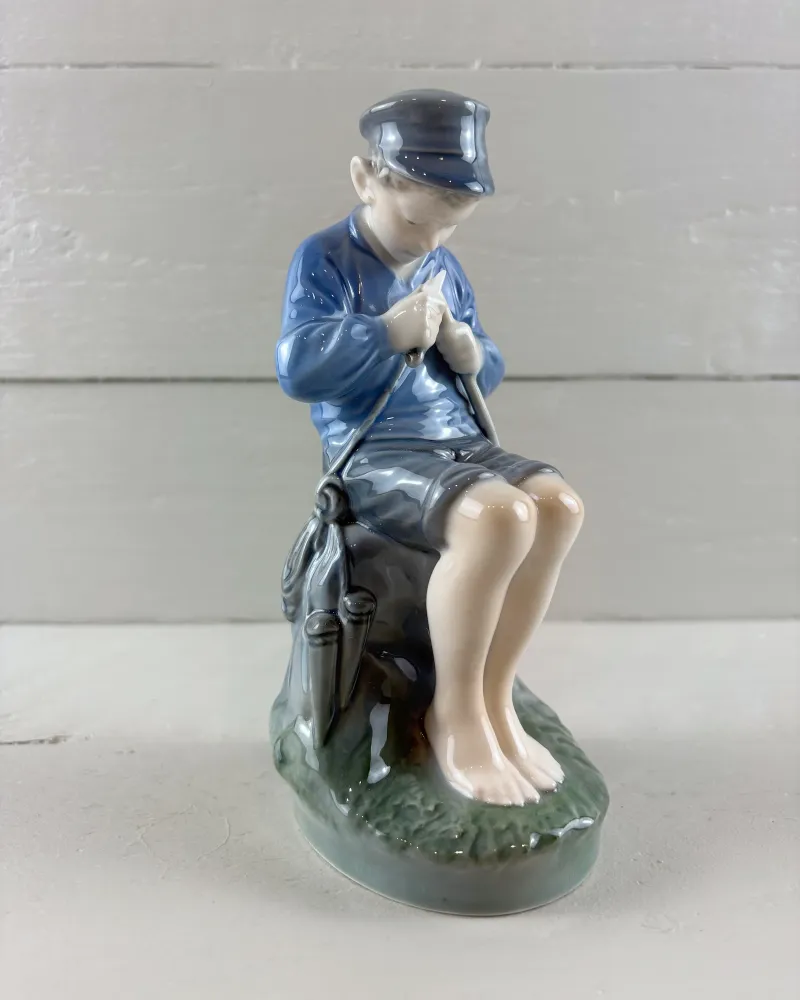
Besides figures, he modelled around thirty-six commemorative plaques and is also associated with the 1908 Danish Christmas plate, a design in the long-running Royal Copenhagen series. Within the figurine range he is perhaps best known for his depictions of ordinary people and children, handled with a quiet attentiveness rather than sentimentality. A seated barefoot boy absorbed in carving a stick, catalogued as model 905 and generally dated to 1908, is a typical example: the pose is simple, the anatomy carefully observed, and the palette of blues, greys and greens keeps the figure calm.
Many of his models stayed in the catalogue for decades, so a design from the 1900s can turn up in later versions with factory marks from the 1960s or 1970s. For collectors this makes the marks on the underside the key to dating a particular piece, while the model number identifies the design itself. Dealer listings also describe examples carrying an artist's signature with his initials on the base, which is worth looking for on figures attributed to him.
Thomsen's legacy is largely the sheer breadth and consistency of the figures he left behind. Together they form a large part of what many people picture when they think of classic Royal Copenhagen porcelain: modest subjects, soft colour and careful modelling, produced in a tradition that Danish ceramics is still known for.
 01