Sidse Werner (1931–1989) was a Danish designer whose name is tied above all to the lamps she drew for the glassworks Holmegaard in the 1980s, among them the Apotheker series. Her career moved between interior design, furniture, textiles, glass and lighting, and she belonged to a generation of Danish designers who saw everyday objects as an expression of how people want to live.
She opened her own design studio in 1970 and worked for two Danish glass producers, Odense Glasværk and later Holmegaard, which she joined towards the end of the 1970s. At Holmegaard she worked alongside Michael Bang, and together they shaped much of the factory's lighting range during the following decade. Outside glass, she also designed coat racks for Fritz Hansen in the 1970s.
Her lamp designs span more than a decade. Early pieces such as the Skibslampen from 1973 and the Stavlampen and Country Line from 1976 were followed by the Troll table lamp and the Isblomst candlesticks in glass, both from the 1970s. At Holmegaard the 1980s brought the Tivoli lamp, the Apotheker series, the Kropendel and the Phoenix, a lamp blown from a single piece of opal glass in the middle of the decade. Dates for individual models vary slightly between sources, so the years given here are approximate.
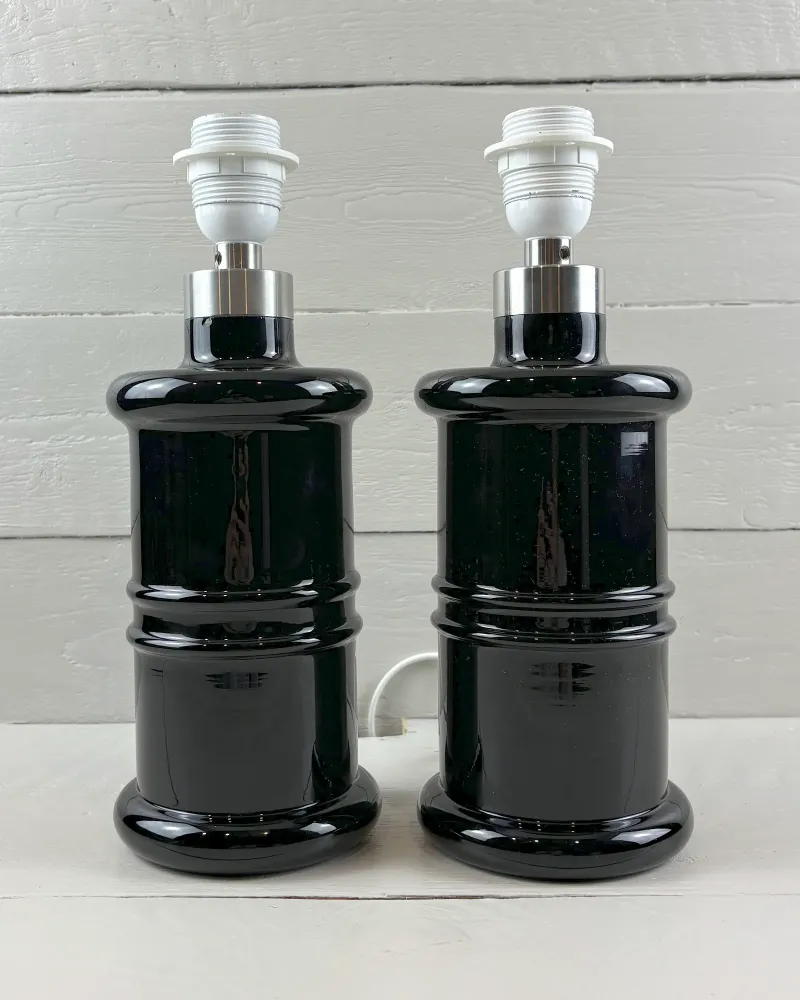
Werner's lamps are built from simple, well-proportioned volumes. The Apotheker shape recalls an apothecary jar: a cylindrical glass column with a broad shoulder, fine ridges around the middle and a rolled foot, fitted with a metal collar and socket. The glass itself carries the design. Opal white and deep black versions rely on gloss, reflection and the clean outline of the body rather than on applied decoration, and the sources that discuss her work often point to nature as a starting point for her forms.
Today her Holmegaard lamps are sought after by collectors of Danish glass and lighting from the 1980s. A lamp is best judged by the condition of its glass body and metal fittings and by whether its original parts are still in place. Her work is a useful reminder that Danish design of the late twentieth century was not only about the teak furniture of the 1950s and 1960s, but also about industrial glass made with a clear, quiet sense of form.
 01