Few porcelain makers in Europe can match the staying power of Royal Copenhagen, the Danish manufactory that began firing hard-paste porcelain in Copenhagen in 1775. It was set up under the patronage of the Queen Dowager, Juliane Marie, around the chemist Frantz Heinrich Müller, and started life in a former post-yard building on Købmagergade. Its first customers were the court and the royal household, and the three wavy lines that still appear on the back of its porcelain are usually explained as the three Danish straits: the Øresund, the Great Belt and the Little Belt.
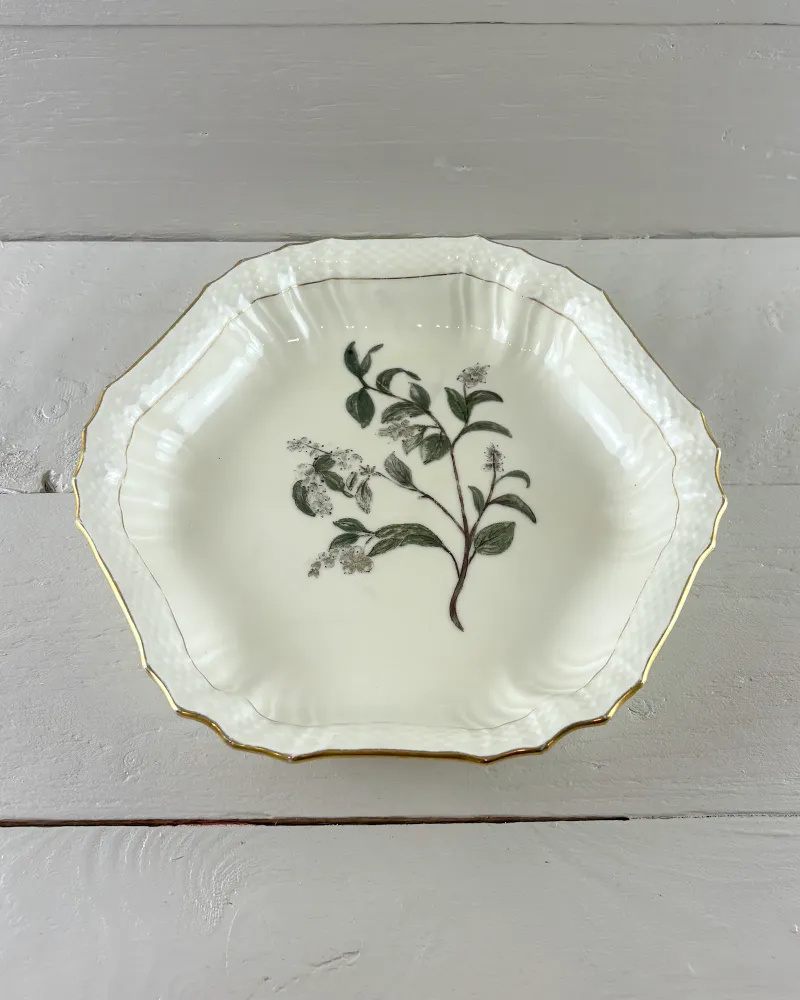
The best-known early commission is the Flora Danica service, ordered in 1790 and finished in 1802 after more than a decade of work. Each piece carries a botanical study taken from the Flora Danica plant illustrations, and the service is reportedly meant as a diplomatic gift for Catherine the Great of Russia. Hand-painted Flora Danica is still made in Denmark today. The cobalt-blue Blue Fluted pattern, number one in the factory's pattern list and dating back to the first years of the firm, remains in production.
The company changed course in the nineteenth century. It passed into private ownership in 1868, and in 1882 it was bought by the owners of Aluminia, a Copenhagen faience factory founded in 1863 and led by Philip Schou. Production moved to the Aluminia site in Frederiksberg in 1884, and a year later the architect Arnold Krog became artistic director, a post he held until 1916. Krog revived underglaze painting, mixing Japanese-inspired composition with close observation of nature, and the results won a Grand Prix at the Paris world fair of 1889.
That tradition fed straight into the figures and animals for which Royal Copenhagen is now widely collected. Naturalistic models of people, children, birds and farm animals appeared from the late 1800s, and sculptors such as Christian Thomsen, who joined in 1898, and Gerhard Henning, whose figures date from around 1909, gave the range its recognisable calm. Annual Christmas plates began in 1908. The faience side of the business continued separately under the Aluminia name until 1969.
Over the following decades the company grew by absorbing other Danish names: it acquired Georg Jensen in 1972, merged with the Holmegaard glassworks in 1985 and took over Bing & Grøndahl in 1987. In 1997 it joined Orrefors Kosta Boda to form Royal Scandinavia, and at the end of 2012 the Finnish group Fiskars bought the brand from its private-equity owner. Today the porcelain is made in Thailand, while Flora Danica is still painted in Denmark.
For collectors, the back stamp is the most useful guide. A crown and three waves is the constant, but the wording and tiny details change with the era: a "DANMARK" mark is associated with 1894–1900, a standard Royal Copenhagen mark with 1901–1923, and from the 1940s small dots or bars beside particular letters shift from one period to the next. Combined with the model number and any artist signature on the base, these marks usually place a piece in a specific period.
 01
 02
 03
 04
 05