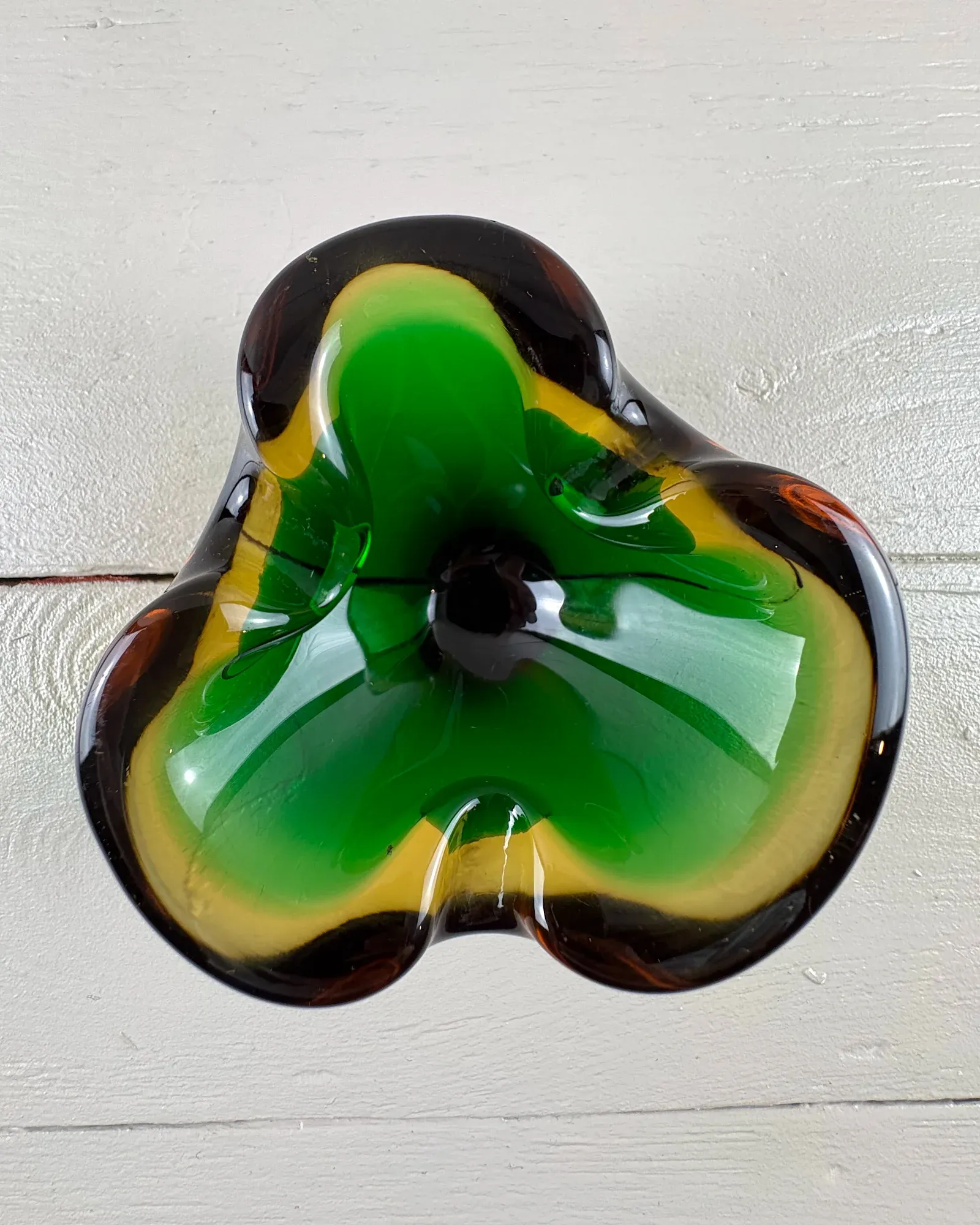
This trefoil ashtray is made in the sommerso technique: a core of emerald green glass submerged in a casing of honey yellow and deep brown. The colours, the thick-walled body and the hand-shaped form are consistent with Murano glass of around the 1960s to 1970s, though no maker's mark has been documented, so the exact origin is not confirmed. It works as an ashtray, a trinket dish or a small sculptural object, with a three-lobed outline that reads like a leaf from above.
Sommerso, Italian for "submerged", means dipping a gather of coloured glass into molten glass of another colour, so that the layers stay separate instead of blending. The method was developed on Murano in the 1930s and reached a wide audience in the 1950s through designers such as Flavio Poli at Seguso Vetri d'Arte, after which many workshops on the island produced their own versions. Similar layered glass was also made elsewhere in Europe, and the maker of this piece has not been identified.
The colour changes as the eye moves outward. Green fills the centre, a narrow band of yellow follows, and the thick rim is so dark that it looks nearly black until light passes through it and turns it amber. Each of the three lobes has a shallow dip in the rim, a feature typical of ashtray forms. From the side the body is a deep, rounded cup that tapers to a small foot. Because every piece was shaped by hand, the proportions of this one are its own.
 01 / 05